The following is a list of films I watched between June and November 2026 in the cinema, archives, other non-cinematic screenings, and film festivals in Singapore, London, Kota Bharu, Kuala Lumpur, and on the Criterion Channel, and my reflections on cinephilia in a year of film-watching. See Part 1 for my Fassbinder mania and other films.
- The Voice of Hind Rajab (2025, dir. Kaouther ben Hania)
- Backrooms (2025, dir. Kane Parsons)
- A Good Marriage (1980, dir. Eric Rohmer)
- My Night at Maud’s (1969, dir. Eric Rohmer)
- The Bakery Girl of Monceau (1963, dir. Eric Rohmer)
- Suzanne’s Career (1963, dir. Eric Rohmer)
- La Collectionneuse (1967, dir. Eric Rohmer)
- Claire’s Knee (1970, dir. Eric Rohmer)
- Love in the Afternoon (1972, dir. Eric Rohmer)
- À Bout de Souffle (1960, dir. Jean-Luc Godard)
- The Night of the Hunter (1955, dir. Charles Laughton)
- Cape Fear (1991, dir. Martin Scorsese)
- Zombi Kampung Pisang (2007, dir. Mamat Khalid)
- Wildcat (2023, dir. Ethan Hawke)
- A Canterbury Tale (1944, dir. Michael Powell and Emeric Pressburger)
- Gourmet Baby (2001, dir. Sandi Tan)
- Someday My Prince Will Come (2011, dir. Ezzam Rahman)
- To Kill the Birds and the Bees (2021, dir. Calleen Koh)
- Gunkworld (2020, dir. Mark Chee)
- I Can’t Sleep Tonight (1995, dir. K. Rajagopal)
- sighnight (2024, dir. Jake Low)
- The Seventh Seal (1957, dir. Ingmar Bergman)
- The Story of Sulaymane (2025, dir. Boris Lojkine)
- Dreams (2024, dir. Dag Johan Haugerud)
- Dreamers (2025, dir. Mahen Bala)
- We are the Jungle (2025, dir. Gwai Lou)
- Jom Kita ke Laut: Itui Suli-suli Bajau! (2026, dir. Zan Azlee)
- Tomorrow is Spring (2024, dir. Kristishyaa Karunagaran)
- Diam (2024, dir. Sufina Saqidin)
- Hujan Panas (2011, dir. Nadiah Hamzah)
- Where Time Stood Still (2022, dir. Mary Grace Liew)
- Empat Musim Pertiwi (Four Seasons in Java, 2026, dir. Kamila Andini)
- Sleep No More (2026, dir. Edwin)
- Permata di-Perlimbahan (1952, dir., Haji Mahadi)
- Penda’s Fen (1974, dir. Alan Clarke)
- Amreeka (2009, dir. Cherien Dabis)
- The Invite (2026, dir. Olivia Wilde)
There are likely to be fewer women cinephiles than there are men, and I wonder why that might be the case. One can only speculate; a male-dominated industry that addresses the default male audience typically begets the male fan, critic, cinematographer, and filmmaker, and the cycle continues henceforth.
Let’s consider the very watching of film as a gendered activity; who puts in the time to watch a lot of films? Between women and men, what kinds of films are they more predisposed to watch, and what do they say about those films, if they do so at all?
My sense is that – if films are seen as merely ‘entertainment’ (they’re not) – most people don’t really have much to say about the films they’ve watched other than ‘It’s OK’, ‘good/not great’, ‘I liked X or Y better’. But when you’ve watched a lot of films and become a little more discerning, you may want to say a little more than ‘It was OK/good/not great’. Perhaps you’ll create a list, ranked, and rated. Over time, you will develop ‘taste’ – a refined knowledge of what you like, what you will spend your time and money watching, and what you won’t watch because enough knowledge tells you they are probably unworthy of your time and money.
Is patriarchy the reason why men outshine women as cinephiles? To watch many films, you need to devote chunks of time and not be easily distracted by other things that take up your time. Is a woman’s time in a day more fragmented to make way for an endless litany of responsibilities let alone the mental load that swallows up our bandwidth? Maybe. What happens after watching a film; does a woman’s opinion about it matter, or does a man ignore her or shut her down? When was the late time you heard a man nattering on endlessly about his favourite auteur? When did you last hear a female film buff speaking about a film as an art form rather than as content? If a male film fan expresses his herd-mind admiration for Christopher Nolan and Denis Villeneuve, is there a female fan equivalent speaking reverently about a woman film director? No? well maybe it’s a good thing if there isn’t one.
At a few film festivals I attended this year (see Fig. 1 below for one example), I noticed that women enjoy listening to post-screening discussions. For some, it is what they look forward to more than the film themselves. The films you can watch (nearly) anytime, anywhere, but the discussions that come after are site and time-contingent and ephemeral. If one can be so generous, the discussions can be considered the intellectual envelope surrounding the film. Listening in to the discussion can re-shape the experience of the film they’ve just watched, filling in the knowledge gaps they might have had. Most times, however, men do most of the talking. They talk simply for the sake of sharing their (usually anodyne) thoughts.
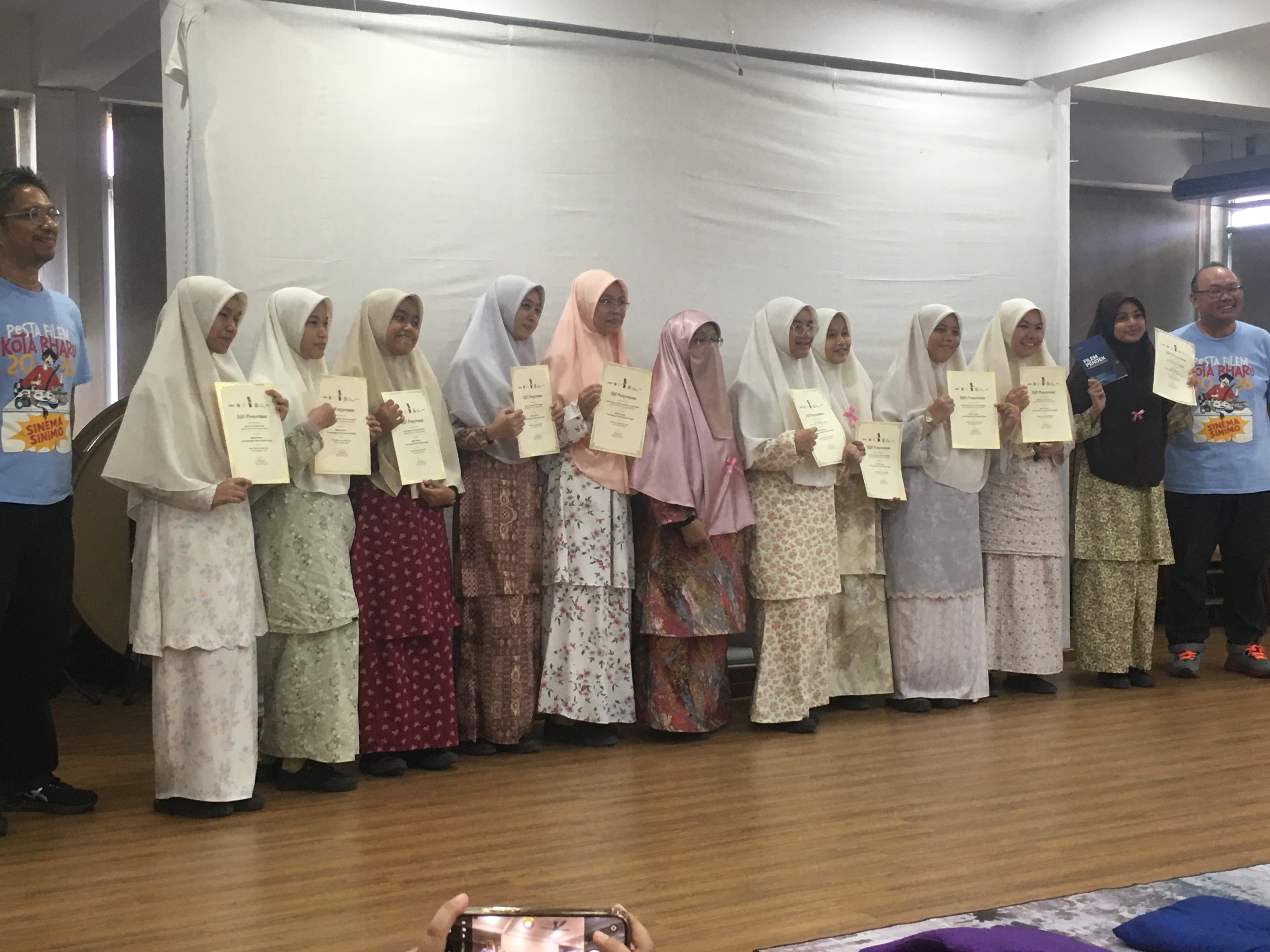
Knowing that there’s more to an opinion about a film than ‘I liked it’, ‘That was “good”’, or worse, “I don’t know enough to say anything”, is the beginning of film literacy. Often, audiences are afraid to say they dislike a film they had just seen, because they have to have explain why, a judgment that does not always arrive immediately to mind. Women are less likely to unapologetically express their disapproval of a film, lest they disrupt the peace or face male aggression for disagreeing or for simply expressing an opinion (see my opening salvo in a previous post).
Perhaps thinking aloud and talking freely about films – i.e. the formation of film literacy – needs a supportive space. The problem with being a female cinephile is that many male film geeks are creeps or just insecure bores who do not respect female film geeks as their equals. Women who enjoy films are not always so competitive about their film knowledge and not seeking to impress men. What women cinephiles can demonstrate is that they know as much if not more than men. And too often straight men use mutual enthusiasm about film as a pathetic pretext to fish romantic and sexual attention from women. Thus, talking freely about the way films make us (women) feel, see, hear, and haptically experience extraordinary sensations is not safe in the presence of men. In other words, cinephilia is not always a safe activity for women when men are around.
One very encouraging development in these past few years, witnessed primarily in the privileged spaces of the film festivals around the region, is that young women are making and showing their films. Most are short films, but they serve as calling cards of their nascent career as filmmakers. Many of these independently-made films go beyond the familiar territory of race and gender – the totemic subjects of independent filmmakers who have come before. They are also quite eloquent and socially-engaged, ready to speak with their audiences who occupy similar social and geographic positions.
What women’s cinephilia boils down to is this: the enthusiastic pursuit to show and watch any and as many films as possible; the more aesthetically challenging and obscure the better. It means watching the films that influenced respected filmmakers, artists, and writers, and inserting themselves adjacent or in critical opposition to their spheres of taste. Women’s film literacy does not need male validation; thus, be bold to always seek, to dissent, to disagree, to dislike.


